 English
 Korean



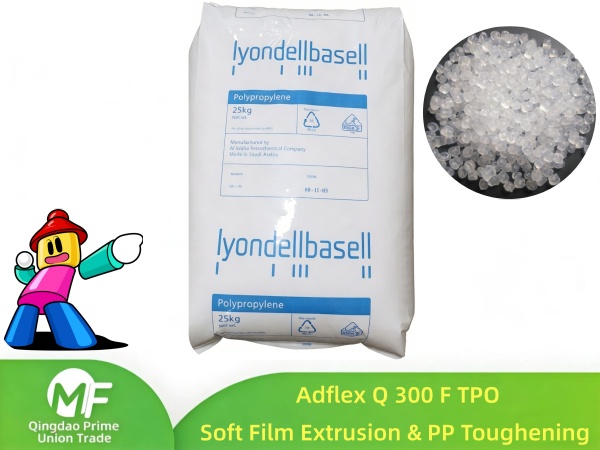
Adflex Q 300 F TPO – Catalloy Soft Film and PP Toughening Grade
Soft film extrusion often forces a compromise between low density and sufficient stiffness, while impact modification trials with conventional elastomers can consume weeks of compounding time before a stable dispersion is reached. Adflex Q 300 F is a thermoplastic polyolefin produced via LyondellBasell’s Catalloy multi-reactor process, with a nominal density of 0.88 g/cm³. In our experience supplying this grade to film processors and compounders, its value lies in removing that compromise: the propylene-based Catalloy structure disperses readily in PP homopolymer and processes on existing PP extrusion, PVC calendering, and LDPE/LLDPE blown film lines without major equipment changes.
Product Specifications
The following typical values are drawn from LyondellBasell’s public Technical Data Sheet. They are typical properties, not specification limits. Test conditions are noted in the standard column.
| Property | Typical Value | Unit | Test Method |
|---|---|---|---|
| Melt Flow Rate (230 °C / 2.16 kg) | 0.8 | g/10 min | ISO 1133-1 |
| Density (23 °C, Method A) | 0.88 | g/cm³ | ISO 1183-1 |
| Flexural Modulus | 330 | MPa | ISO 178 |
| Tensile Stress at Break | 13 | MPa | ISO 527-1, -2 |
| Tensile Stress at Yield | 9 | MPa | ISO 527-1, -2 |
| Tensile Strain at Break | 550 | % | ISO 527-1, -2 |
| Tensile Strain at Yield | 35 | % | ISO 527-1, -2 |
| Charpy Notched Impact, 23 °C | 70 | kJ/m² | ISO 179 |
| Charpy Notched Impact, −20 °C | 100 | kJ/m² | ISO 179 |
| Shore Hardness, Shore D | 36 | — | ISO 868 |
| Vicat Softening Temperature (A50) | 78 | °C | ISO 306 |
| Heat Deflection Temperature B (0.45 MPa, unannealed) | 50 | °C | ISO 75B-1, -2 |
| Melting Temperature | 163 | °C | ISO 11357-3 |
| Haze | 95 | % | ASTM D1003 |
| Gloss (45°, 50 μm) | 4 | — | ASTM D2457 |
One observation worth flagging for low-temperature applications: notched Charpy impact is higher at −20 °C (100 kJ/m²) than at 23 °C (70 kJ/m²). This inversion is characteristic of the Catalloy multiphase morphology and has practical relevance for cold-chain packaging and winter-exposure film.
Key Properties
Low-density flexibility with dimensional stability. At 0.88 g/cm³ and Shore D 36, Adflex Q 300 F TPO delivers a soft, slightly velvety surface without sacrificing the stiffness needed to hold a bottle or tube shape. A cosmetics packaging converter we work with replaced part of a conventional elastomer in a tube outer layer and reported a visible improvement in surface hand-feel while maintaining sufficient rigidity for filling-line handling.
Dispersion efficiency in PP homopolymer toughening. When used as an impact modifier for PP homopolymer in extrusion, the propylene-based Catalloy chain segments promote interfacial compatibility with the PP matrix. A strapping manufacturer incorporating this grade reported reduced fibrillation at high draw ratios, effectively widening the drawing process window.
Processing versatility across lines. The grade runs on conventional PP extrusion equipment, PVC calenders, and standard LDPE/LLDPE blown film lines. Processors switching from other TPO or POE grades typically do not need to reconfigure screw profiles or overhaul temperature curves.
Food-contact compliance foundation. The base resin meets FDA 21 CFR 177.1520(a)(3)(iii) and (c)3.4 for olefin polymers, and complies with EU 1935/2004/EC framework requirements and EU 10/2011/EC for plastic food-contact materials at the intermediate-material stage. Finished-article migration testing remains the responsibility of the converter.
Applications
Soft-touch protective film. A film processor formulating surface-protection film for PE or PP substrates used Adflex Q 300 F to tune peel force and flexibility. The low flexural modulus helps reduce adhesive residue during lamination, and the film remains flat through winding and unwinding.
Soft-touch consumer bottle and tube surfaces. A packaging converter blended this grade with PP for cosmetics bottle outer layers. The matte, fine-textured surface improved grip, while the polyolefin compatibility of the Adflex Q 300 F TPO grade minimized the risk of interfacial delamination between the outer layer and the structural layer.
PP strapping and heavy-duty packaging film. In strapping extrusion, the grade’s documented effect on fibrillation at high draw ratios is the primary draw. In heavy-duty film, the 550% tensile strain at break provides formulators with room to balance dart impact and puncture resistance.
Technical Comparison: Catalloy TPO vs. Metallocene POE
| Dimension | Adflex Q 300 F (Catalloy TPO) | Typical Metallocene POE |
|---|---|---|
| Polymerization | Multi-reactor Catalloy, propylene-based multiphase | Metallocene-catalyzed ethylene/α-olefin copolymer |
| Density range | 0.88 g/cm³ | Typically 0.86–0.90 g/cm³ |
| Compatibility with PP | Propylene-based segments favor interfacial bonding with PP | Interfacial tension with PP may require compatibilizer in some formulations |
| Processing line fit | PP extrusion, PVC calendering, LDPE/LLDPE blown film | Primarily PE processing lines |
This is not a ranking. The propylene-based Catalloy architecture of Adflex Q 300 F TPO typically offers more direct compatibility in PP toughening and PP/TPO blends. Metallocene POE retains its place in pure PE systems or where an exceptionally low glass transition temperature is required. Grade selection should be driven by the base resin and the available processing line, not by the broad “metallocene” label alone.
Supply Chain and Logistics
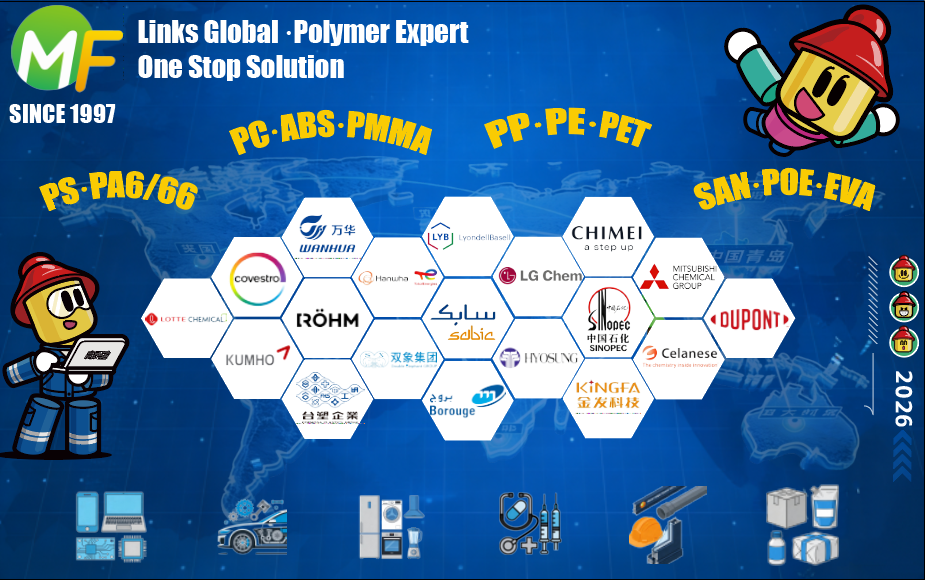
Qingdao Prime Union Trade Co., Ltd. has distributed engineering thermoplastics since 2002 and is an authorized distributor for LyondellBasell, Chimei, SABIC, Hanwha TotalEnergies, and Hyosung, with direct supply relationships covering Mitsubishi, Röhm, Double Elephant, and LG. The product portfolio includes ABS, PC, PP, PMMA, and EVA. Adflex Q 300 F is available through Prime Union’s supply network.
The company operates four owned warehouses across China and is registered in the Qingdao bonded port area, supporting bonded trade, re-export trade, processing trade under manual, and general trade. These trade modes allow buyers to align material flow with their customs registration status and inventory planning. For formulators requiring related polyolefin options, Prime Union also supplies other PP and polyethylene grades through the same channel.
The sister company, Qingdao Primetech Plastics Co., Ltd., provides in-house compounding and color solutions for PC, ABS, PP, PA, PBT, PPS, PPA, and PETG, covering toughening, filling, alloying, flame retardancy, coloring, and medical-grade masterbatch. Standard colors and basic modifications follow a 3-day sample and 7-day production rhythm. Primetech can support Adflex Q 300 F-based blend development where downstream modification is required.
Frequently Asked Questions
Q: How does Adflex Q 300 F differ from a metallocene POE in PP toughening?
A: If the matrix is PP homopolymer or copolymer and the goal is to reduce compatibilizer loading while running on an existing PP extrusion line, the propylene-based Catalloy structure of Adflex Q 300 F typically disperses more directly. If the system is predominantly PE, or if the formulation requires an exceptionally low density for maximum softness, a metallocene POE may be the more natural starting point. A side-by-side trial at the target impact level is the most reliable way to decide.
Q: What food-contact documentation is available?
A: The base resin meets FDA 21 CFR 177.1520 and EU 10/2011/EC requirements at the intermediate-material stage. Compliance of the finished article, including overall and specific migration testing, remains the converter’s responsibility. Product Stewardship Bulletin documentation is available to support regulatory review.
Q: Can Adflex Q 300 F run on a standard LDPE blown film line?
A: Yes, it can be processed on standard LDPE/LLDPE film lines. Because the melt flow rate is 0.8 g/10 min, melt viscosity differs from conventional LDPE. We recommend starting with a lower extrusion temperature profile, observing bubble stability and draw ratio, and adjusting gradually rather than transferring an existing LDPE recipe without modification.
Q: Are samples available, and how is the sample cost handled?
A: Samples are fee-based, with the sample cost credited toward the first full order.
Q: What trade modes can support a trial order?
A: General trade and processing trade under manual are both supported, and bonded transit can be arranged for qualified buyers. The appropriate mode depends on the buyer’s customs registration and the intended end use. Specific documentation requirements can be confirmed at the inquiry stage.
Conclusion
Adflex Q 300 F combines a 0.88 g/cm³ Catalloy TPO structure with documented low-temperature impact behavior and broad line compatibility, offering formulators a data-backed starting point for soft film flexibility and PP toughening efficiency, supported by Prime Union’s bonded-port trade infrastructure and Primetech’s downstream compounding capability.
Source: LyondellBasell Industries Holdings, B.V. – Adflex Q 300 F Technical Data Sheet – Public TDS. Food-contact status referenced from Basell Sales & Marketing Company B.V. – Adflex Q 300 F Product Stewardship Bulletin – February 24, 2021.
Enterprise strengths

Resources Diversification
241 years of experience as import and export engineering plastic agent, with a full range of agent brands and more diverse options.

Comprehensive Customized Services
Industry and trade integration, 19 years of experience in modified plastic, pre-sales, sales and after sales technical support services.
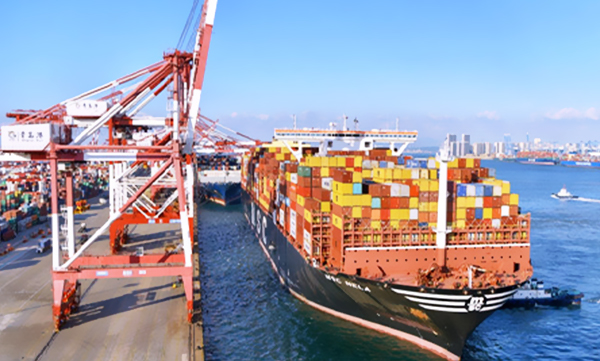

Convenient Transportation
Close to natural harbor ---Qingdao port,makes more efficient the import and export operations.
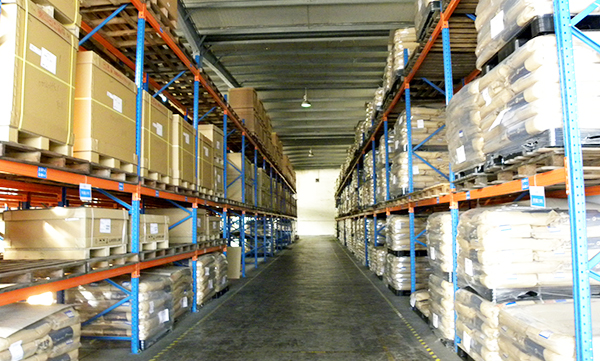

Flexible Trading Methods
According to the commerce handbook “commerce manual + general trade ”, a variety of trade methods, bonded area warehouse with sufficient inventory.
Global Recognized Certifactions
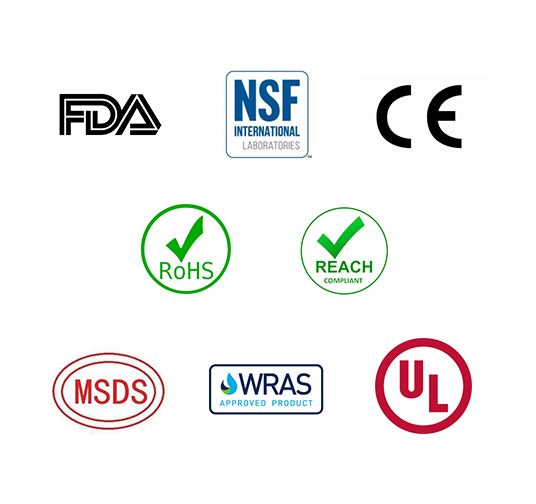
Global Recognized Certifactions
If you require certificates in PDF format or complete datasheets, please contact us directly.